
Pokemon is one of the biggest anime franchises ever. With a full and competitive series of games and cards, it is very developed.
This guide will cover the competitive Pokemon battle, with the online game Pokemon Showdown.
The concept of Pokemon is simple: you choose 6 of them to be on your team, and then fight with other players. The games are always turn based, where you take your turn with your Pokemon, and then the other player does so as well. The first player to use attacks that make all 6 of the opponent’s Pokemon faint will win that battle.
The Basics
Each player is allowed one attack that they get to use on their turn. This attack is chosen from a Pokemon’s moveset of 4 moves. Once one player uses a move, the other player uses another move, and then the turn ends.
Stats
The stats of a Pokemon play a huge role in deciding how effective any attack is on another Pokemon.
Speed (Spe) and Priority
The speed of a Pokemon determines the turn order. When two Pokemon face off, the Pokemon with a higher speed will usually go first. Speed doesn’t matter, however, when you are using a priority move. Showdown will usually tell you if a move is priority if you hover your mouse over a move. Priority will override speed, meaning that if you use a priority move, you will usually go first. There are also different levels of priority, however, and if your opponent uses a higher priority than you do, they will go first. Moves usually have a 0 priority, where in that case, speed will determine the turn order.
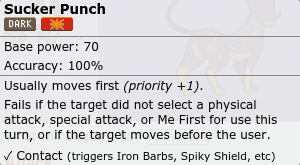
Sucker Punch has a +1 priority, and will usually move first
Sucker Punch is a physical attack (yellow and red symbol)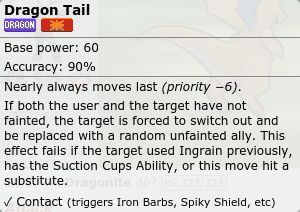
Dragon Tail has a -6 priority, and will probably move last
Dragon Tail is a physical attack (yellow and red symbol)

Symbol indicates a special attack. 
Symbol indicates a physical attack. 
Symbol indicates a status move.
Attack, Defense, Special Attack, and Special Defense (Atk, Def, SpA, SpD)
Attack and Special Attack are very close to the same stat. If you use a move that will directly touch the opponent (You can figure it out with the name: Tackle, Body Slam, Dragon Tail, etc.) it is called a physical attack. The damage for this type of attack is calculated with the Attack stat in mind. If you attack a Pokemon with a Special Attack, the Special Attack stat is used to calculate damage.
The defense stats work the same way, but they help to curb enemy attack damage. If someone attacks you with a physical attack, the defense stat is used to help curb damage. The Special Defense stat is used for special attacks.
Typing
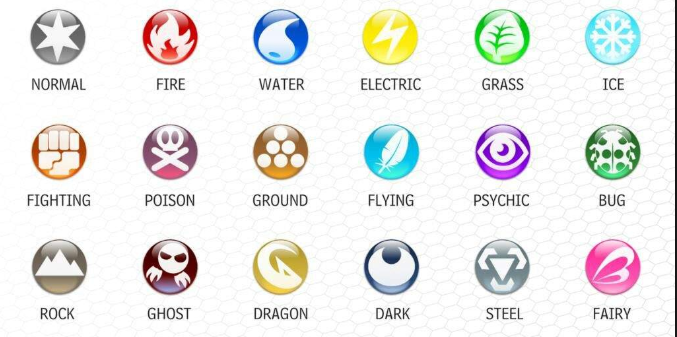
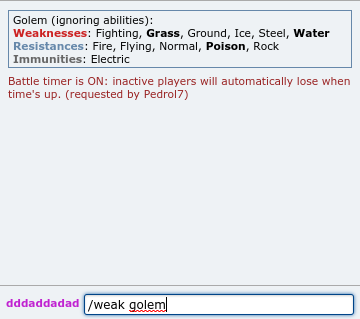
All Pokemon and their moves will have a type. There are 18 different types, and each one has different weaknesses and resistances. For example, if you used a water type move on a fire type Pokemon, then your move will deal twice the normal damage. This is called a super effective move. Likewise, if a fire type move is used on a water type Pokemon, then the move will only deal half as much damage. This is called resistance. There are a lot of way that these types interact, and it does help to memorize them. But in Showdown, you don’t need to! If you go to the chat bar and type “/weak” and then a Pokemon’s name, the game will tell you exactly what that Pokemon is weak and resistant to. This way you can make more informed decisions about the moves you make. Any type that may appear in bold for a certain Pokemon means that it is doubly weak or doubly resistant to a move of that type. For instance, a rock-type move on Charizard does 4x damage to him, so a rock type move would be a wise choice to use against Charizard. Be careful, because some Pokemon are also immune to select types of moves! Any Ghost type, like Gengar, is immune to fighting type moves. This means that your move will do no damage to the opposing Pokemon, and you have wasted your turn! The /weak command will tell you about this too, but beware!

Hover your mouse over a move to see information about it. (Power, Type of Attack, Type, Other Effects) 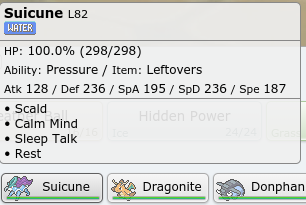
Hover your mouse over a Pokemon to see information about it. (Moveset, stats, Type, HP, Ability, Item, Level)
Status
Special and Physical moves are the two types of attacking moves. But a status move doesn’t deal any damage. It instead inflicts a status or changes the stats of a Pokemon.
Paralysis (PAR)
When you paralyze a Pokemon, their speed is cut in half. They also have a 25% chance of not being able to use a move every turn that they are paralyzed. Electric Pokemon cannot be paralyzed.
Poisoning (PSN)
A poisoned Pokemon will lose 1/8 (12%) of their maximum HP even turn. Poison and Steel type Pokemon cannot be poisoned.
Badly Poisoned (TOX)
A badly poisoned Pokemon will lose 1/16 (6%) of their maximum HP on their first turn. The damage then stacks by 1/16 more HP every turn! The second turn will deal 1/8 (12%) of damage, and the third turn will deal 3/16 (18%) of damage. This stacking effect ends when the Pokemon is switched out.
Burning (BRN)
A burned Pokemon will have its Attack stat cut in half, and 1/16 (6%) of damage is dealt to the Pokemon at the end of each turn.
Freezing (FRZ)
A frozen Pokemon will not be able to attack. It can be thawed out, however, by some moves. Most of these thawing moves are Fire-type, and Showdown will tell you if a move can thaw out of a freeze.
Confusion
When a Pokemon is confused, it has a 50% chance of damaging itself. A Pokemon can snap out of confusion in 1 to 4 turns.
Infatuation
A Pokemon can be infatuated by a select set of moves, and infatuation behaves like confusion.
Leech Seed
After a Pokemon uses the move Leech Seed, the opposing Pokemon is inflicted with a Leech Seed. A Leech Seed will steal 1/16 of a Pokemon’s maximum HP and give it to the opposing Pokemon. This effect can be extremely annoying at times, but switching Pokemon will end the seeding effect.
Flinch
Some moves have a slight flinch chance, which makes the opponent unable to attack that turn.
These are all statuses that you can inflict upon your opponent. But some status moves can make your own status better by increasing your stats, such as your attack or physical attack. But make sure that you have the right attacks to make use of your stats! If you start raising your attack but you only have a special attack moveset, then the increased attack isn’t going to result in increased damage.
Stats
The Stages of Stats
When you read a move’s description, you may encounter something like: “Raises attack by one stage” or “Lowers defense by 2”.
This refers to the number of stages that your stats get multiplied by. One stage is equal to +1/2 of your current multiplier. If you current multiplier of attack is 1 (no stat changes) and you raise your attack by 1 stage, the new attack multiplier is 1.5. Two stages will increase you multiplier from 1x to 2x!
Lowering stages work likewise. For defense, for example, lowering three stages will put your multiplier at 2/3, or 0.66x multiplier.
Strategy
If you are switching into another Pokemon, you may consider using a Pokemon that has an attack boosting move, like Swords Dance or Calm Mind, and then sweeping with that Pokemon.
Be sure you use switches wisely! Switch only when you have to, because switching takes a valuable turn and your opponent gets the opportunity to deal damage to you with none in return. If you can manage to find a move on a Pokemon that will deal extra damage, then you may consider switching.
Read your opponent. If you switch to a Pokemon that is super effective on the other one, then read the switch and take advantage of it. Maybe if you know that they will switch at a certain time, you can use a crippling move on them.
Know the items and abilities. They aren’t there for nothing. If an opponent is spamming a certain move, maybe the item is forcing them to do so. Take advantage of this. Perhaps you may want to prepare a powerful attack, or put up defensive moves. If you predict an opponent’s switch, you give yourself valuable time.
The key to improving, however, is to play new games. Don’t be afraid to try new strategies. Learn from your losses. And never give up.
 The Aimless Blog